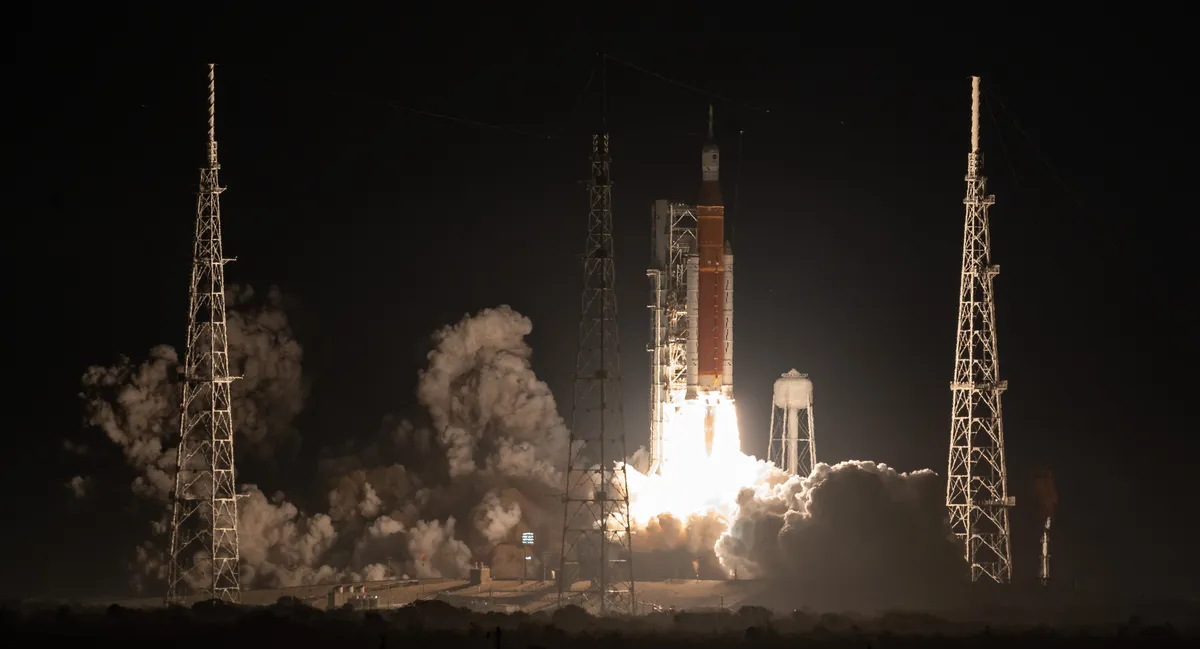
The upcoming NASA Artemis II mission, set to launch on April 1, 2026, represents a pivotal moment in human space exploration. This mission will be the first crewed venture of NASA’s Artemis program, and it aims to rekindle the spirit of global unity that was once ignited by the Apollo missions. With a diverse crew of four astronauts—Reid Wiseman, Victor Glover, Christina Koch, and Jeremy Hansen—Artemis II will not only push the boundaries of exploration but also mark several historic firsts, including the first time a woman, a person of color, and a non-American astronaut will travel to the Moon.
Scheduled to last approximately 10 days, the mission will perform a lunar flyby before returning to Earth, without landing on the Moon. This will be the first human spaceflight mission beyond low Earth orbit since Apollo 17 in 1972, a significant leap after 50 years of robotic exploration. The crew will launch aboard NASA’s Space Launch System (SLS) rocket and the Orion spacecraft, designed to withstand the harsh conditions of space.
However, the path to this historic mission has not been without challenges. NASA has faced delays and rising costs, relying on private companies for critical components. The Artemis II mission carries inherent risks, including untested life support systems and potential solar radiation exposure. As NASA emphasizes, precision and risk management are essential, given the agency’s history of spaceflight tragedies.
As the crew prepares for this monumental journey, they are acutely aware of the stakes involved. “The only thing standing between the crew and that inferno is what is called a heat shield, a thick protective layer at the base of the capsule designed to absorb and shed that heat,” an expert noted, highlighting the mission’s technical challenges.
NASA has stated it does not plan to perform another wet dress rehearsal (WDR), which means that there are fewer boxes to check during this second stint at the pad. Nevertheless, a malfunction during the 10-day mission, millions of kilometers away from the nearest help, would leave the crew with extremely limited options.
As the launch date approaches, uncertainties remain. Details regarding the effectiveness of the untested life support system during the mission are still unconfirmed, and the impact of increased solar activity on the mission is unclear. NASA’s long-term vision includes building infrastructure near the lunar South Pole, which could pave the way for future lunar exploration.
In a world where space exploration can unite nations, Artemis II stands as a beacon of hope and ambition. The mission aims not only to explore the Moon but to inspire a new generation of scientists, engineers, and dreamers. With the launch just around the corner, the eyes of the world will be on Kennedy Space Center, where history is set to unfold once again.