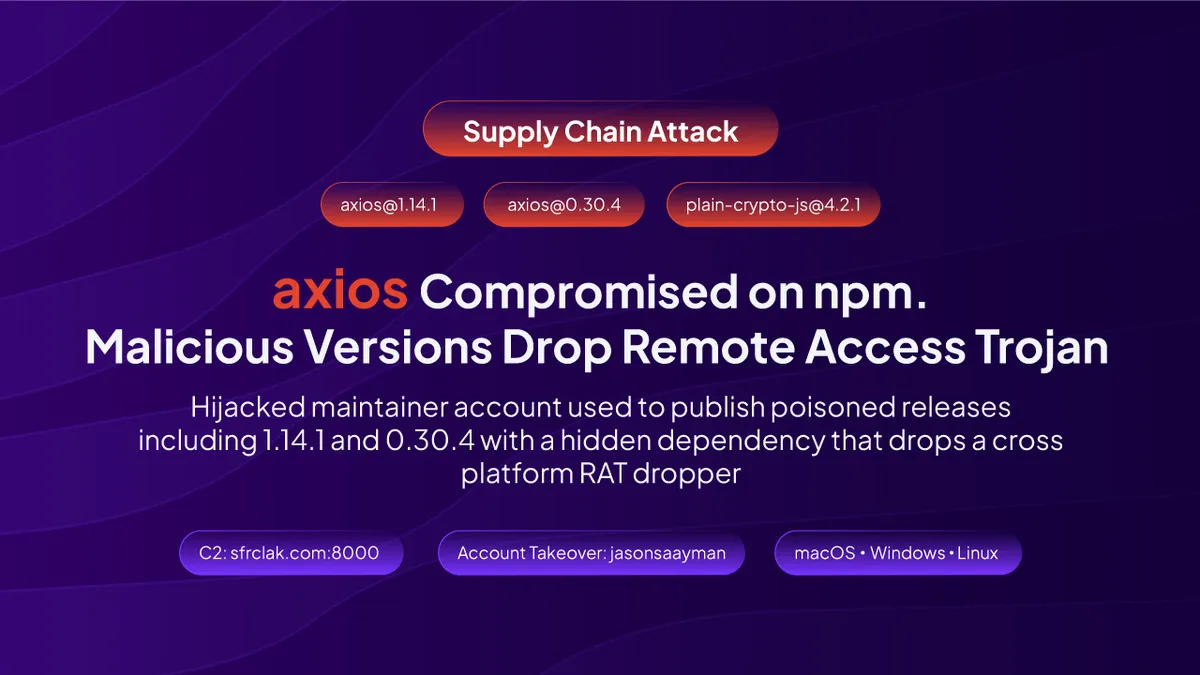
In a startling development for the software development community, two malicious versions of the popular JavaScript HTTP client library axios were published on npm on March 31, 2026. The versions, v1.14.1 and v0.30.4, were live for approximately 2 hours and 53 minutes and 2 hours and 15 minutes, respectively, before being removed shortly after discovery. This incident has raised significant concerns about the security of widely used software packages and the potential vulnerabilities they may harbor.
The immediate circumstances surrounding this event are alarming. The malicious versions were published using compromised credentials of a lead maintainer of axios, an organization that boasts over 100 million weekly downloads and is utilized in approximately 80% of cloud and code environments. The attackers injected a malicious package, plain-crypto-js@4.2.1, as a dependency, which was designed to evade detection by appearing legitimate. This sophisticated approach highlights the growing threat of supply chain attacks in the software ecosystem.
Before the malicious versions were published, the attack was pre-staged across roughly 18 hours, indicating a high level of planning and operational sophistication. The malicious package was designed to execute a postinstall script that contacts a command-and-control server, effectively turning affected systems into targets for further exploitation. The attack was detected by StepSecurity’s AI Package Analyst and Harden-Runner, which alerted developers to the potential risks posed by these malicious versions.
Key moments
While the malicious versions of axios were live for a short period, they managed to execute in 3% of affected environments, raising serious concerns for developers who rely on this widely used library. The attacker even went so far as to change the maintainer’s account email to an anonymous ProtonMail address, further complicating the response efforts. As the dust settles, organizations are being urged to audit their environments for any potential execution of these malicious versions.
This incident serves as a stark reminder of the vulnerabilities that can exist within the software supply chain. As one expert noted, “There are zero lines of malicious code inside axios itself, and that’s exactly what makes this attack so dangerous.” The fact that such a well-regarded library could be compromised in this manner underscores the need for vigilance and proactive security measures in software development.
In light of this attack, the community’s response has been swift. Experts are advising organizations to conduct thorough audits of their codebases and dependencies to ensure they are not inadvertently using compromised versions. The connection to the command-and-control server was automatically marked as anomalous because it had never appeared in any prior workflow run, highlighting the importance of continuous monitoring and anomaly detection in software environments.
As the software development landscape continues to evolve, incidents like this one will likely become more common. The axios attack serves as a critical wake-up call for developers, emphasizing the need for robust security practices and awareness of potential threats. With the increasing reliance on open-source libraries, understanding the risks associated with supply chain vulnerabilities is more important than ever.
In the aftermath of this event, the software community must come together to strengthen security protocols and share knowledge about best practices. As we navigate this complex landscape, the lessons learned from the axios incident will undoubtedly shape the future of software development and security.