Introduction
NASA astronaut Suni Williams has gained international recognition for her remarkable contributions to space exploration and her inspiring journey as a woman of Indian descent in a predominantly male-dominated field. Her achievements serve as a powerful testament to diversity in science and exploration, making her a role model for young aspiring astronauts and scientists around the globe.
Early Life and Education
Born on September 19, 1965, in Euclid, Ohio, Sunita “Suni” Williams grew up in a family that valued education and hard work. She graduated with a Bachelor of Science degree in physical science from the United States Naval Academy in 1987, later earning a Master of Science degree in engineering management from the Florida Institute of Technology. Her military career as a naval aviator set the stage for her eventual selection as a NASA astronaut.
NASA Career
Williams was selected as a NASA astronaut in 1998, following a rigorous selection process. She completed her first spaceflight in 2006 on the Space Shuttle Discovery as part of mission STS-116. During this mission, she became the first woman of Indian origin to walk in space, a groundbreaking achievement that brought attention to women in STEM fields.
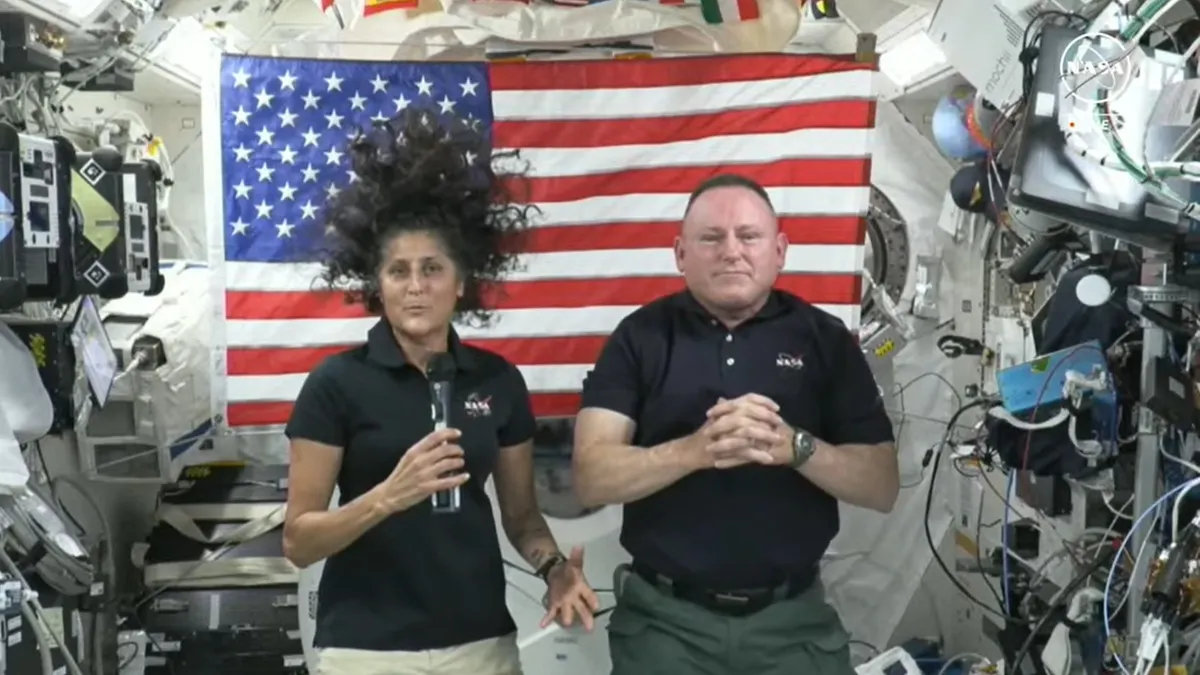
She returned to space in 2012 for the Expedition 33 mission aboard the International Space Station (ISS), where she spent a record 322 days in space, making her one of the longest-serving female astronauts. During her time in space, Williams conducted numerous experiments and contributed to scientific research that explores living and working in space.
Recent Developments
As of October 2023, Williams is again in the spotlight as she prepares for the Artemis II mission, which aims to return humans to the Moon. This mission is notable because it will be the first crewed lunar mission in more than 50 years, and Williams’s involvement highlights the ongoing commitment to advancing human spaceflight and exploration. The mission is expected to launch in 2024, and Williams’s participation confirms her role as a pioneering astronaut in a new era of space exploration.
Conclusion
Suni Williams’s journey is not only a tribute to her resilience and determination but also serves as an inspiration for the next generation. Her efforts in breaking barriers and embracing challenges demonstrate the essential contributions women make in the field of space exploration. As we look forward to future missions, including Artemis II, Williams’s legacy will undoubtedly inspire countless individuals to pursue their dreams in science, technology, engineering, and mathematics (STEM) fields.