Political Landscape Before the 2026 Election
Before the recent elections in Baden-Württemberg, the political landscape was characterized by a clear division among the major parties, with the AfD struggling to gain significant traction. The party had previously achieved only 9.7% of the votes in the 2021 election, which was considered a low point for a party that has been classified as right-wing extremist by the Baden-Württemberg Office for the Protection of the Constitution. Markus Frohnmaier, who has been a Bundestag member since 2017 and serves as the deputy chairman and foreign policy spokesperson for the AfD faction, was seen as a rising figure within the party, but his influence was limited by the party’s overall performance.
Decisive Changes in the 2026 Election
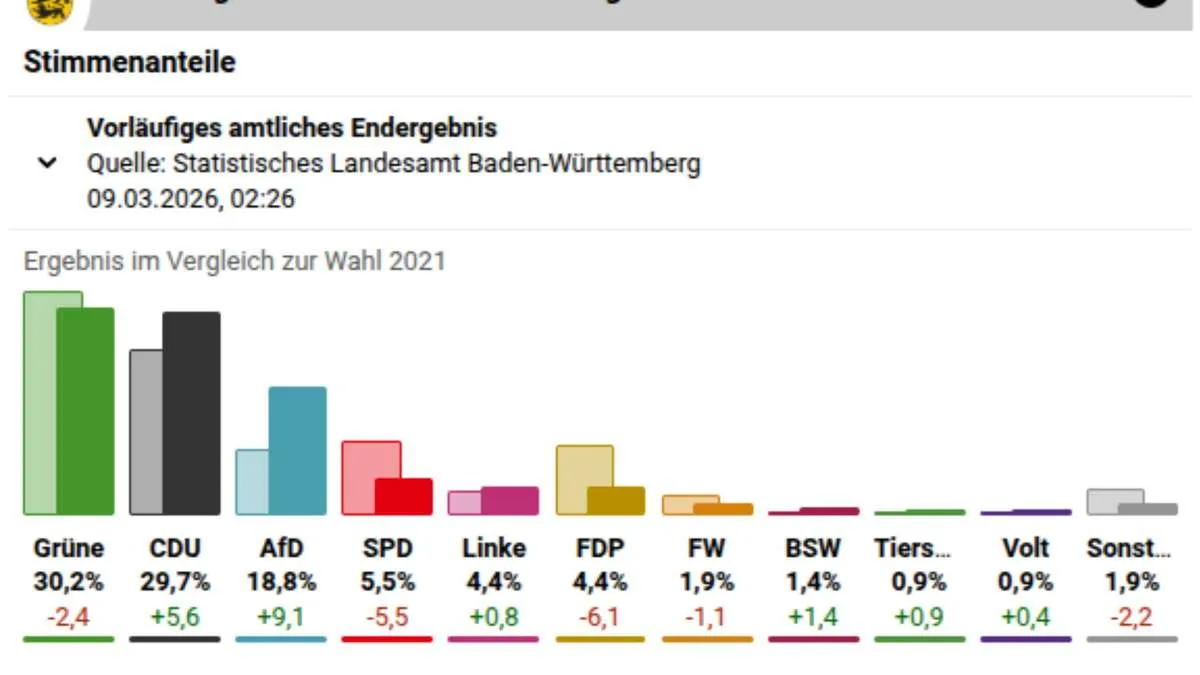
The situation shifted dramatically during the 2026 Baden-Württemberg election held on March 8. The AfD secured 18.8% of the votes, marking a significant 9.1% increase from the previous election. This surge in support was unexpected and indicated a growing acceptance of the party’s platform among voters. However, despite being the AfD’s candidate for Ministerpräsident, Frohnmaier was not on the ballot for the 7.7 million eligible voters, which raised questions about his potential role in the new political landscape.
Immediate Effects on the AfD and Its Leadership
The immediate aftermath of the election results saw Alice Weidel, a prominent AfD leader, expressing satisfaction with the party’s performance, noting that it represented a doubling of their previous results. This newfound support positioned the AfD to likely become the largest opposition party in the Baden-Württemberg parliament, a significant shift that could alter the dynamics of governance in the region. Frohnmaier’s role, however, remains complicated as he cannot be elected without being on the ballot.
Expert Perspectives on the Shift
Political analysts have pointed out that Frohnmaier’s connections to Russia and his controversial background, including accusations of nepotism regarding his wife’s employment, may influence public perception of the AfD. His statement, “Die AfD ist eine bürgerlich-konservative Partei. Vielleicht schaffen wir’s ja auch irgendwann mal auf ‘nen Espresso,” reflects an attempt to position the party as a mainstream conservative option. However, the skepticism surrounding the party’s extremist classification continues to loom large.
Reactions from Other Political Figures
Responses from other political figures have been mixed. Manuel Hagel from the CDU stated, “Für mich ist kein Amt der Welt so wichtig, dass ich mich mit Stimmen der AfD dort hineinwählen lasse,” indicating a reluctance to collaborate with the AfD despite their electoral gains. Meanwhile, Cem Özdemir emphasized the need to ensure that the AfD does not gain further strength in future elections, stating, “Was die AfD angeht, ist für mich völlig klar: Der Auftrag des Regierens ist, alles dafür zu tun, dass die AfD beim nächsten Mal schwächer ist.” This highlights the ongoing tensions between the AfD and other political entities in the region.
Frohnmaier’s Background and Future Prospects
Markus Frohnmaier, born in Romania and adopted by a German couple, has risen through the ranks of the AfD, co-founding the now-dissolved youth organization Junge Alternative. At 34 years old, he represents a younger generation within the party, yet his future prospects remain uncertain given the complexities of his candidacy and the party’s classification. As the AfD navigates its role as a major opposition party, Frohnmaier’s leadership will be scrutinized closely.
The 2026 election results have undeniably shifted the political dynamics in Baden-Württemberg, with the AfD emerging as a significant player. However, the challenges facing Frohnmaier and the party, including public perception and internal controversies, will be critical in determining their future trajectory. Details remain unconfirmed regarding the long-term implications of this electoral shift.