Political Landscape Before Recent Developments
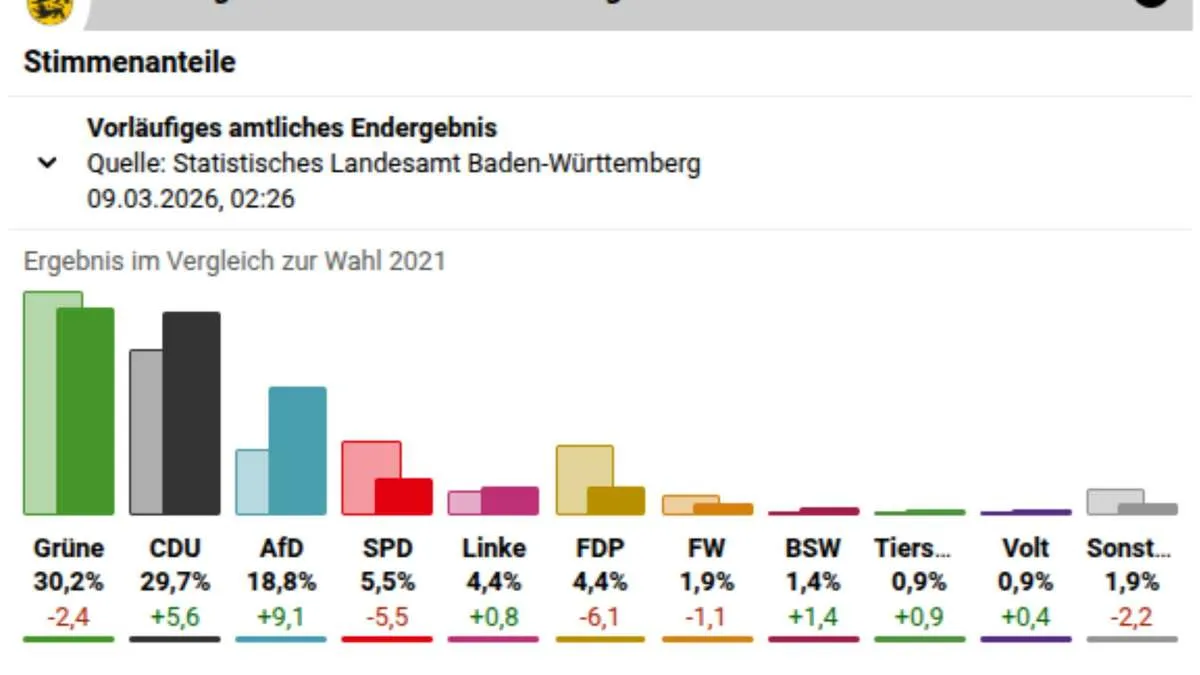
Prior to the recent state election in Baden-Württemberg, the Alternative for Germany (AfD) was considered the smallest opposition party, garnering only 9.7% of the vote in the 2021 state election. This positioned the party as a minor player in the political arena, overshadowed by more established parties. Markus Frohnmaier, a Bundestag member since 2017 and deputy chairman of the AfD faction, was the party’s candidate for Ministerpräsident, but his eligibility was in question as he was not on the ballot for the 7.7 million eligible voters.
Decisive Changes in the Political Arena
In a significant shift, the AfD achieved 18.8% of the vote in the 2026 Baden-Württemberg state election, marking a 9.1% increase from 2021. This surge in support not only elevated the AfD’s status but also indicated a growing acceptance of its platform among voters. Frohnmaier’s political aspirations, however, remained complicated by his lack of eligibility for election, as he was not on the ballot, which raised questions about his future role within the party.
Immediate Effects on Political Dynamics
The immediate aftermath of the election results saw the AfD poised to become the largest opposition party in the Baden-Württemberg state parliament. This change has direct implications for Frohnmaier, who, despite his ineligibility, has been an influential figure within the party, known for his controversial connections to Russia and his previous role as a co-founder of the now-dissolved AfD youth organization, Junge Alternative. His relationship with Alice Weidel, the federal chair of the AfD, has been supportive, further solidifying his position within the party.
Expert Perspectives on the Shift
Political analysts have noted that the AfD’s rise reflects a broader trend of increasing right-wing sentiment in Germany. Alice Weidel remarked, “Das läuft auf eine Verdopplung unseres Ergebnisses hinaus, und damit können wir sehr zufrieden sein,” indicating satisfaction with the electoral outcome. In contrast, Manuel Hagel of the CDU expressed reservations about collaborating with the AfD, stating, “Für mich ist kein Amt der Welt so wichtig, dass ich mich mit Stimmen der AfD dort hineinwählen lasse.” This highlights the contentious nature of the AfD’s growing influence and the challenges it faces in gaining broader acceptance.
Contradictions and Controversies
Frohnmaier’s political journey is marked by contradictions. While he positions the AfD as a “bürgerlich-konservative Partei” and seeks collaboration with other parties, the AfD is classified as a right-wing extremist suspect by the Baden-Württemberg Office for the Protection of the Constitution. This duality complicates Frohnmaier’s efforts to present the party as a legitimate political force while navigating its controversial reputation.
Looking Ahead
The future of Markus Frohnmaier and the AfD in Baden-Württemberg remains uncertain. As the party seeks to consolidate its gains and expand its influence, Frohnmaier’s role will be pivotal, especially in light of his connections and the support he has garnered from party leadership. However, the political landscape is fraught with challenges, as other parties, including the Greens and the CDU, prepare to counter the AfD’s rising prominence.
As the AfD continues to evolve and adapt to the changing political climate in Baden-Württemberg, the implications of Frohnmaier’s involvement and the party’s electoral success will be closely monitored. The dynamics of collaboration and opposition will shape the future of political discourse in the region, with Frohnmaier at the center of these developments.