Tech Mahindra’s Financial Performance Update
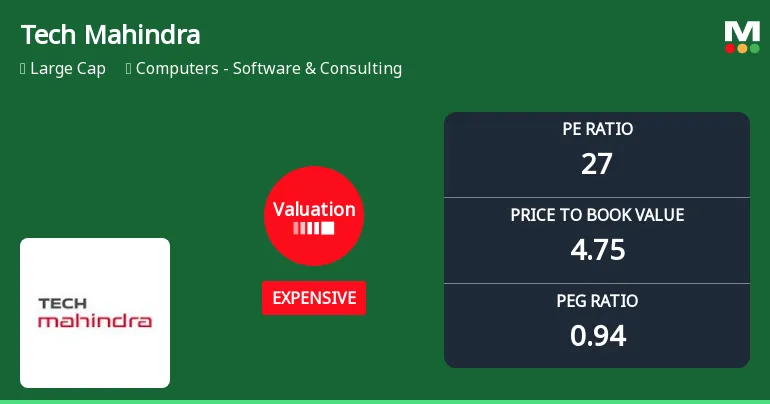
As of March 6, 2026, Tech Mahindra reports a price-to-earnings (P/E) ratio of 27.06, reflecting its current market valuation amidst a challenging month where its share price has declined by 19.02%, now standing at ₹1,333.00.
In addition to the P/E ratio, the company has a price-to-book value (P/BV) ratio of 4.75 and a PEG ratio of 0.94, indicating a relatively attractive valuation compared to its earnings growth potential. The dividend yield is also noteworthy at 3.37%, which may appeal to income-focused investors.
Tech Mahindra’s return on capital employed (ROCE) is reported at 26.62%, while the return on equity (ROE) stands at 16.31%. These metrics suggest that the company is effectively utilizing its capital to generate profits.
Despite the recent decline in share price, Tech Mahindra has shown resilience over the long term, delivering a remarkable 195.24% return over the past decade, closely tracking the Sensex’s appreciation of 224.65% during the same period.
The company’s Mojo Score is currently at 50.0, and it holds a market capitalization grade of 1, indicating its status as a large-cap entity. The 52-week price range for Tech Mahindra has been between ₹1,209.70 and ₹1,850.00, highlighting the volatility in its stock performance.
Amol Phadke, Chief Transformation Officer of Tech Mahindra, noted, “Network operations centers still rely on rule-based, open-loop workflows with significant manual intervention,” emphasizing the need for innovation in operational processes.
In a strategic partnership with NVIDIA, Tech Mahindra aims to enhance its capabilities in the telecom sector. Chris Penrose, Vice President of Global Business Development at NVIDIA, stated, “By combining NVIDIA’s AI software stack with Tech Mahindra’s deep telecom expertise, this collaboration enables CSPs to deploy reasoning-based AI systems that can act, adapt, and learn within live NOC environments.” This collaboration highlights Tech Mahindra’s commitment to leveraging advanced technologies for improved service delivery.
As the company navigates through current market challenges, observers will be keenly watching how these financial metrics and strategic initiatives impact its future performance.