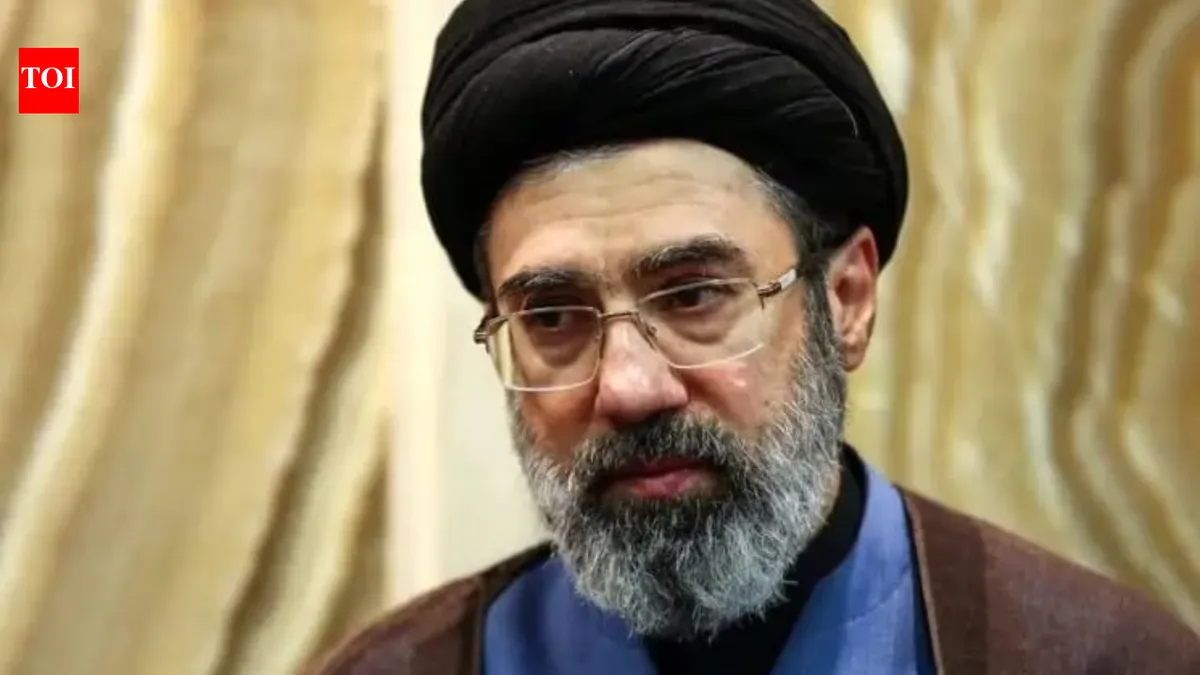
Mojtaba Khamenei: The Next Supreme Leader of Iran?
Mojtaba Khamenei is the son of the late Supreme Leader Ali Khamenei. The process of selecting the Supreme Leader, the criteria involved, and how Ali Khamenei was appointed in a single day are explained below.
Rapid Read
The Iranian Supreme Leader Ayatollah Ali Khamenei was killed in a significant attack on Iran orchestrated by Israel and the United States, casting uncertainty over the future of the Islamic Republic and heightening the potential for regional instability.
Mojtaba, son of Iranian Supreme Leader Ayatollah Ali Khamenei, was present at the annual Quds Day event in Tehran, Iran. (AP File)
US-Israel War On Iran Live Updates Today
Reports indicate that Mojtaba Khamenei is being considered as Iran’s new Supreme Leader.
Iranian state television and the state-run IRNA news agency confirmed the 86-year-old’s death early Sunday. U.S. President Donald Trump announced his death hours earlier, stating it presented Iranians with their “greatest chance” to “take back” their country.
The announcements followed a coordinated U.S. and Israeli aerial bombardment targeting Iranian military and governmental sites. Trump indicated that the “heavy and pinpoint bombing” would persist throughout the week or as long as necessary.
The strikes marked a dramatic escalation in U.S. involvement in Iran, representing the second attack by the Trump administration in eight months during negotiations concerning its nuclear program. The assassination of Khamenei, who had been in power for decades, is expected to create a significant leadership void due to the lack of a known successor and the Supreme Leader’s ultimate authority over all major policies.
On Sunday, Iran’s paramilitary Revolutionary Guard threatened to initiate its “most intense offensive operation” ever against Israel and U.S. bases.
Who is Mojtaba Khamenei?
Mojtaba Khamenei is an Iranian cleric and a prominent political figure, recognized as the second-eldest son of the late Supreme Leader Ali Khamenei. Born on September 8, 1969, in Mashhad, Iran, he has long been perceived as one of the most influential members of Iran’s clerical elite, despite not holding formal government positions.
Mojtaba pursued religious studies at the Qom Seminary and advanced within conservative clerical networks, establishing strong connections with the Islamic Revolutionary Guard Corps (IRGC) and the Basij militia. He briefly served in the IRGC during the Iran-Iraq War and later became deeply involved in Iranian political affairs behind the scenes, often acting as a significant adviser and gatekeeper within the Supreme Leader’s office.
Although he has never held an official government role, Mojtaba’s influence arises from his control over key clerical and security networks, his support for hardline political figures, and his involvement in internal security decisions, including alleged participation in the suppression of protests following the disputed 2009 election.
Due to his behind-the-scenes power and his status as the Supreme Leader’s son, he has frequently been speculated as a potential successor to the leadership, particularly after other prominent contenders, such as former President Ebrahim Raisi, were eliminated or sidelined. Critics argue, however, that he lacks the top clerical rank and broad legitimacy traditionally expected of a Supreme Leader, and that dynastic succession would be contentious within Iran’s republican framework.
In addition to his clerical role, investigations have linked Mojtaba to substantial financial networks and assets abroad, highlighting his economic influence beyond Iran’s religious and political spheres.
How is the Supreme Leader of Iran Chosen?
The Supreme Leader of Iran is selected through a constitutional process defined by the Islamic Republic’s system.
- Who Has the Authority?
An 88-member clerical body, elected by the public every eight years (candidates are vetted), is responsible for appointing, supervising, and if necessary, dismissing the Supreme Leader. They are the only body that formally selects the successor. - What Happens Immediately After the Leader’s Death?
Upon the Supreme Leader’s death or incapacitation, Article 111 of Iran’s Constitution mandates a three-person interim council to assume duties — the President, the head of the judiciary, and a senior cleric from the Guardian Council. This arrangement is temporary and lasts only until a new Leader is appointed. - How the Successor Is Selected
The Assembly of Experts convenes urgently to review candidates who must be a senior Islamic jurist (marja-level not strictly required anymore), politically and religiously qualified, and capable of leadership under Iran’s Islamic system. They vote internally (majority decision) and can choose either a single Supreme Leader (most likely scenario) or a Leadership Council (rare but constitutionally allowed). - Behind-the-Scenes Power Dynamics
While the Assembly makes the formal decision, the Islamic Revolutionary Guard Corps (IRGC) holds significant informal influence. Senior clerics in the Qom religious establishment also play a crucial role, and political factions (hardliners vs. pragmatists) engage in intense negotiations. Elite consensus often shapes the outcome prior to the formal vote. - Possible Types of Successors
Although no official list exists publicly, analysts often discuss a hardline cleric aligned with the security establishment, a more politically experienced figure, or a compromise candidate to maintain stability. - How long does it take?
Constitutionally, the process should occur as quickly as possible. Practically, it is likely to take days to weeks, not months. Iran has prepared succession mechanisms since the 1989 transition from Ruhollah Khomeini to Khamenei, making a prolonged vacuum unlikely.
How was Ayatollah Ali Khamenei Picked in 1989?
The process was completed in a day after the death of Ruhollah Khomeini on June 3, 1989. The Assembly of Experts convened in an emergency session the following day to select a new Supreme Leader.
At that time, the constitution required the leader to be a top-ranking cleric (a marjaʿ), but no clear consensus candidate emerged, and Khomeini’s designated successor had already been removed. The Assembly debated whether to appoint a leadership council or a single leader and ultimately voted for one individual.
Despite not meeting the highest clerical rank required under the constitution, then-President Ali Khamenei received backing from influential figures, including Akbar Hashemi Rafsanjani, and was elected Supreme Leader. Shortly thereafter, a constitutional referendum eliminated the marjaʿ requirement, effectively validating his selection. This transition was completed within a day, ensuring political stability at a critical juncture for the Islamic Republic.
With Agency Inputs
First Published: March 01, 2026, 12:09 IST